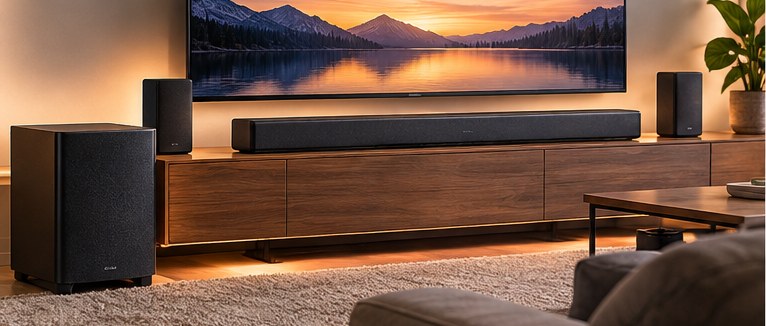
The first question in a soundbar purchase is whether you need clearer speech or a surround system. Those are different budgets and different amounts of equipment. A single bar can make dialogue easier to follow. A bar, subwoofer and rear speakers can place sound around the seating area.
Samsung’s HW-Q990H is our starting point for a complete premium package. Sonos Arc Ultra is the alternative for someone who wants to begin with one bar, particularly in a home that already uses Sonos. Compare the full installed cost before calling either the better value.
Samsung includes the surrounding hardware
The HW-Q990H package includes a main bar, subwoofer and rear speakers. RTINGS identifies an 11.1.4-channel arrangement, Dolby Atmos support and HDMI passthrough. [1] That makes it a more complete purchase than a standalone soundbar with a similar headline price.
The separate rear speakers are the important physical difference. They can produce sound from behind the seat instead of relying entirely on processing and reflections from the front of the room. You need places to put them, and their wireless connection does not remove the need for power.
Check outlet positions, speaker-stand costs and the route to each plug. A living room with no convenient place for the rears may be better served by a simpler setup. Moving the speakers into a cupboard because the wiring is awkward defeats the reason for buying them.
The subwoofer also needs space. Apartment neighbors and sleeping children can make adjustable bass and late-night settings more relevant than maximum output.
Sonos starts with one bar
Arc Ultra can be used alone and expanded with compatible Sonos speakers and a subwoofer. RTINGS’ standalone review supports its dialogue performance while identifying the bass limitations of using a bar without a separate subwoofer. [2]
That suits someone who wants fewer visible boxes or expects to build the system in stages. It is especially worth considering when Sonos multi-room music is already part of the household.
Price each stage before ordering. A bar that looks affordable beside Samsung’s complete package can become the more expensive system after adding surrounds, a subwoofer and stands. Compare the same amount of hardware on both sides.
Do not confuse a review of a Sonos package built around the older Arc with one built around Arc Ultra. The product names are similar enough to make that easy. Use the current Arc Ultra documentation and the review of the configuration you intend to buy.
HDMI connections can rule out a purchase
Enhanced Audio Return Channel, or eARC, allows a compatible TV to send audio to a soundbar over HDMI. It is useful for higher-bandwidth formats, but ordinary ARC can also carry some Dolby Atmos streams. Whether a particular source works depends on the TV, source, audio format and soundbar.
Find the ARC or eARC port on your television and check its audio-passthrough support. A streaming app in the TV and a game console connected to another HDMI port can take different paths to the soundbar.
The Samsung has additional HDMI inputs; Arc Ultra does not provide the same source-switching arrangement. [1][2] If your TV has too few suitable ports, that difference can matter more than a small sound-quality preference.
For games, check the resolution, refresh rate and variable-refresh support of the whole connection. “HDMI passthrough” alone does not tell you what a bar will preserve from a console or computer. Also look for tests of audio delay in the mode you use.
Your ceiling affects height effects
Up-firing speakers are intended to use reflections to create a sense of sound above you. A high, sloped or irregular ceiling can make that job harder. The number of height channels on the carton does not guarantee the same effect in every room.
Rear speakers still need reasonable placement around the listening position. A seat pressed against the back wall leaves fewer options than a sofa with space behind it. Room-correction software can adjust some aspects of sound; it cannot create a missing place to put a speaker.
Measure the bar against the TV stand as well. A tall bar can obscure the bottom of the screen or the television’s remote sensor. Check clearance before buying a model that needs to be moved every time you use the remote.
Clear speech does not require the biggest system
If the complaint is simply that dialogue is hard to understand, begin with the TV’s audio settings. Reduce competing processing and try a speech-oriented mode. That costs nothing and helps establish what remains wrong.
If a bar is still needed, look for intelligible dialogue at the volume you actually use. Loud action scenes in a shop are a poor demonstration for quiet evening viewing. A separate subwoofer and rears become easier to justify when film effects and games are regular priorities.
A conventional receiver and speakers deserve comparison for someone willing to accept more wiring. Soundbars make installation easier; they are not the only way to improve TV sound.
Check last year’s Samsung before buying this year’s
RTINGS finds the Q990H and Q990F similar in much of their measured performance, with newer software functions among the main differences. [1] A substantial discount on a complete Q990F can therefore be a better purchase.
Compare warranty, included speakers, return terms and the actual connections. A marketplace listing for a bar alone is not comparable with a factory package containing the subwoofer and rears.
Choose Q990H or a well-priced Q990F for a room that can accommodate the complete system. Choose Arc Ultra for a simpler starting setup or an existing Sonos household. If speech is the only problem, spend less first and see whether a smaller setup fixes it.
Sources
Sources checked October 5, 2026. Buying recommendations are Znews editorial judgments.
[1] RTINGS, Samsung HW-Q990H review.
[2] RTINGS, Sonos Arc Ultra review.