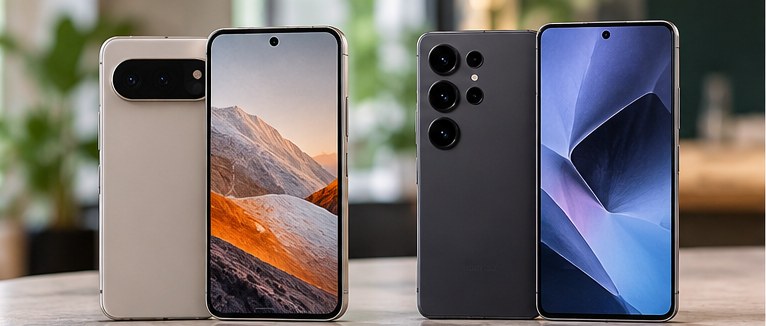
The useful difference between the Pixel 11 and Galaxy S26 is easiest to see in how you use a phone. Google’s camera and call tools favor people who want the software to handle more of the work. Samsung gives you more settings, desktop-style tools and processor performance. Both are compact Android phones with 6.3-inch displays. [1][2]
At similar prices, start with Pixel if you prefer Google’s software and take ordinary photos more often than you play demanding games. Start with Galaxy if you already use Samsung’s devices or expect to use DeX. A substantial price difference can overturn either recommendation.
The software choice comes first
A familiar phone has a real advantage: you know where the settings are, which gestures work and what happens when a call arrives. Moving from Galaxy to Pixel will not make Android unfamiliar, but it will change enough small things to deserve a store visit.
Pixel puts Google’s services and camera tools at the center. Galaxy adds One UI, Samsung’s interface, with its own settings and applications. Some people find that extra layer useful; others would rather have fewer overlapping apps. Try finding the settings you use, changing a notification and opening the camera. Those small tasks are a better demonstration than a prerecorded AI prompt.
DeX is a more specific reason to choose Samsung. If you intend to connect the phone to a display for work, investigate that setup before deciding. If you have never used it and cannot name a job for it, it should carry little weight. The same goes for Pixel-only call features: check your country, language and carrier before counting them as a benefit.
The cameras differ in reach
The Pixel 11 has a 48-megapixel main camera, a 13-megapixel ultra-wide and a 10.8-megapixel telephoto with 5x optical zoom. The Galaxy S26 has a 50-megapixel main camera, a 12-megapixel ultra-wide and a 10-megapixel 3x telephoto. [1][2]
The different telephoto focal lengths matter more than the two-megapixel difference in the main cameras. Pixel gives you a tighter view at its native telephoto setting. Samsung’s 3x is useful for subjects closer to you. Neither number says which phone will give you the photograph you prefer indoors or when a child moves.
Google also lists Magic Capture and several editing tools. [1] Think about whether you want to change an image after taking it. Someone photographing family occasions may value a usable picture immediately; someone creating social posts may be more interested in editing. Look for samples of each job, including the unedited result.
Tom’s Guide’s Pixel 11 review is useful here because it discusses the camera tools alongside the phone’s less impressive hardware changes. [3] Our preference for Pixel as the camera-and-software starting point is a buying judgment, not a claim that it wins every shot.
Samsung is the stronger performance choice
Pixel uses Google’s Tensor G6. The U.S. Galaxy S26 uses Snapdragon 8 Elite Gen 5 for Galaxy; processor configurations can differ by market. [1][2] Tom’s Guide’s comparison puts Pixel behind the S26 in conventional processor and graphics tests. [3]
That gives Samsung the clearer argument for demanding games and heavier processing. It does not mean the Pixel struggles to send messages or run maps. For routine use, either should be judged by the interface you prefer, reception where you live and the applications you need.
Be careful when buying an imported Galaxy. The model, supported network bands, processor and warranty may differ from the U.S. unit in the review. A lower price on a marketplace listing can be buying a different configuration.
Battery capacity is only part of the comparison
Google specifies a typical 4,985 milliamp-hour battery; Samsung specifies 4,300 milliamp-hours. [1][2] In Tom’s Guide’s battery test, the Pixel lasted 12 hours 45 minutes and the S26 lasted 11 hours 28 minutes. [3] Those are results under one procedure, not promises for navigation, video calls or travel.
The measured lead gives Pixel a reason to stay on the shortlist if you want a compact phone and endurance matters. Heavy users should still compare the larger models. A larger battery may be worth the bigger body, but carrying that body is part of the cost.
Charging accessories deserve a check, too. Compare the charger required for the advertised speed with the one you already own. A wireless charging feature is useful only if your stand or pad supports the necessary standard.
Compare the bill, not the advertised trade-in
A trade-in price assumes a qualifying phone in the required condition. Carrier credits can arrive over several years and disappear when you leave the plan. Compare the cash price, the value of the device you surrender and any additional monthly service cost.
For example, an extra $15 a month over three years is $540. That is an illustration of the arithmetic, not an offer from a carrier. It can make a supposedly free phone more expensive than an unlocked purchase.
Choose Pixel 11 if Google’s software, camera tools and measured battery advantage address your needs. Choose Galaxy S26 for stronger processing, Samsung’s desktop and multitasking tools, or continuity with the devices you own. If the choice remains close, a lower unlocked price and a good return policy are reasonable deciding factors.
Sources
Sources checked October 5, 2026. Buying recommendations are Znews editorial judgments.
[1] Google Store, Pixel 11 specifications.
[2] Samsung, Galaxy S26 series specifications and announcement.
[3] Tom's Guide, Google Pixel 11 review, Aug. 27, 2026.